
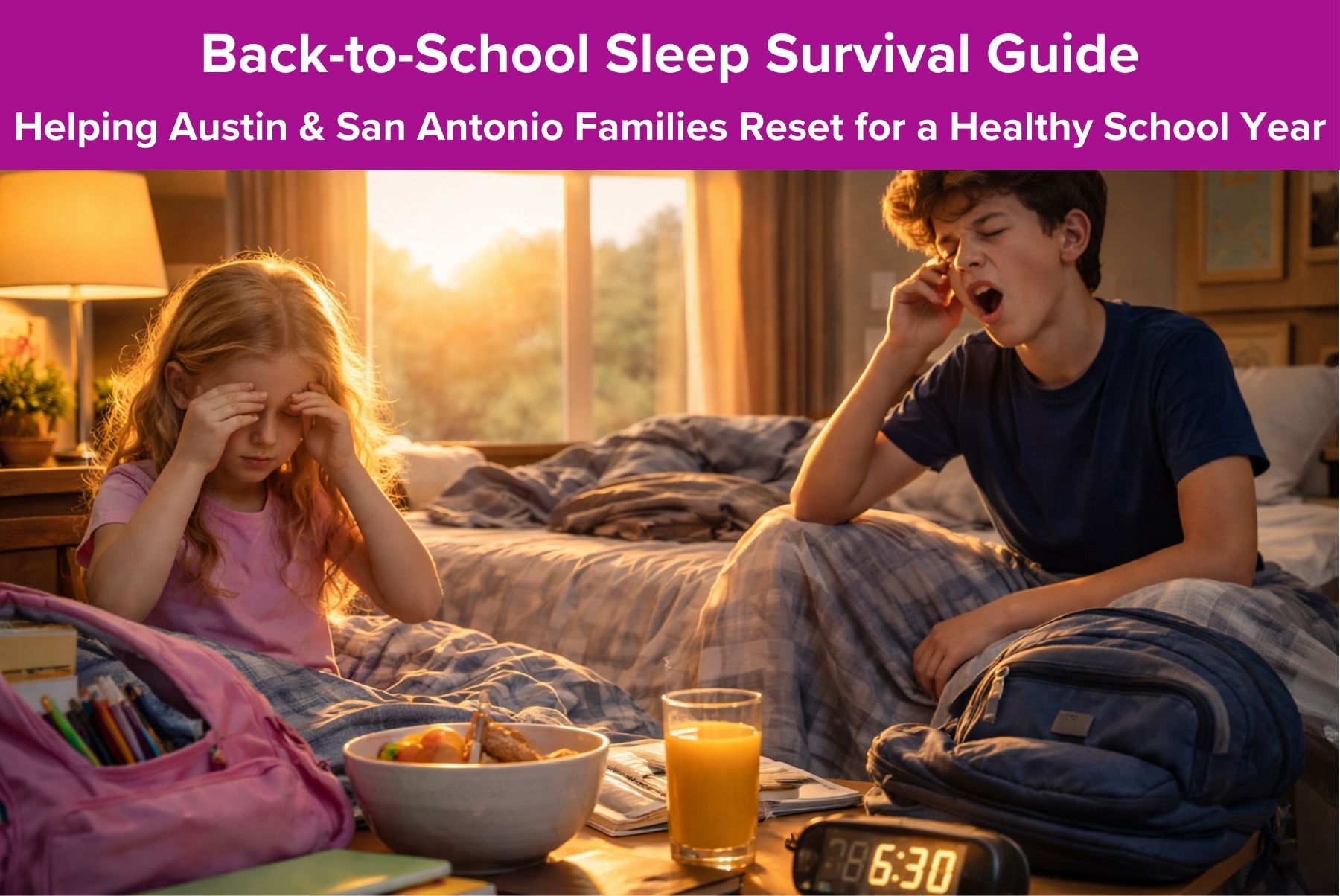
 As summer winds down and backpacks come out of storage, families across Central Texas begin preparing for the return to early mornings, homework, and busy schedules. Between UT Austin move-in, Texas tax-free weekend, and shifting school calendars for Austin ISD, Northside ISD, and NEISD, one essential back-to-school priority often gets overlooked: sleep.
At Sleep Medicine Consultants, we see firsthand how disrupted summer routines can make the transition back to school challenging — especially for teens. This comprehensive guide will help families reset sleep schedules, understand teen circadian rhythms, and create healthier habits for a successful school year.
Why Sleep Matters More During the School Year
Sleep is directly tied to:
- Academic performance
- Mood regulation
- Attention and focus
- Athletic performance
- Immune health
- Mental health
When school start times and sleep needs are misaligned, children and teens are at greater risk for:
- Difficulty concentrating
- Increased anxiety or depression
- Behavioral challenges
- Lower test scores
- Increased illness
For families searching for guidance on back-to-school sleep in Austin or teen sleep in San Antonio, the transition period is the perfect time to establish healthy routines.
The Summer Sleep Shift: What Happens?
During summer, many students:
- Stay up 2–3 hours later
- Sleep in significantly later
- Spend more time on screens
- Lose consistent routines
By August, their internal clocks are shifted — making early wake-ups for school extremely difficult.
Add in late nights during UT Austin move-in week, family gatherings, and end-of-summer activities, and the reset becomes even harder.
Understanding Teen Circadian Rhythm Challenges
Teenagers are not just being “lazy.” Their brains are biologically wired for later sleep.
The Science Behind Teen Sleep
- Teens experience a natural shift in melatonin release.
- They often don’t feel sleepy until 10:30–11:30 PM.
- Yet many schools start between 7:30–8:30 AM.
This mismatch between school start times and sleep biology leads to chronic sleep deprivation.
Why This Matters in Central Texas
Districts such as:
- Austin ISD
- Northside ISD (San Antonio)
- NEISD (San Antonio)
often have early start times for middle and high school students. When teens must wake at 6:00 AM but biologically aren’t ready for sleep before 11:00 PM, they accumulate significant sleep debt.
This is a common concern among families searching for help with teen sleep San Antonio.
How Much Sleep Do Kids and Teens Need?
- Elementary-aged children: 9–12 hours
- Teens (13–18 years): 8–10 hours
- College students (UT Austin freshmen included): 7–9 hours
Unfortunately, studies show most teens average only 6–7 hours during the school year.
2-Week Sleep Reset Plan Before School Starts
1. Shift Bedtime Gradually
- Move bedtime earlier by 15–30 minutes every 2–3 days.
- Do the same for wake-up time.
2. Anchor the Morning Wake-Up
Even on weekends, avoid sleeping more than 1 hour past weekday wake time.
3. Morning Sunlight Exposure
Central Texas sunshine is powerful. Get outside within 30 minutes of waking — it resets the brain’s clock.
4. Create a Wind-Down Routine
Start 45–60 minutes before bed:
- Dim lights
- Take a warm shower
- Read (non-digital)
- Gentle stretching
5. Reduce Screen Time Before School
This is one of the biggest barriers to healthy sleep.
Why Screens Disrupt Sleep
- Blue light suppresses melatonin.
- Social media stimulates the brain.
- Notifications interrupt sleep cycles.
Screen Guidelines
- No screens 60 minutes before bedtime.
- Remove phones from bedrooms overnight.
- Use “Do Not Disturb” mode.
Special Considerations for High School & College Students
UT Austin Move-In & Sleep
College students often experience:
- New independence
- Late-night studying
- Social pressures
- Dorm noise
Encourage:
- Consistent sleep schedules
- Earplugs or white noise
- Limiting caffeine after 2 PM
- Keeping dorm rooms cool and dark
Back-to-School Sleep Challenges in Texas
Texas Tax-Free Weekend Rush
Late nights shopping can throw off schedules. Plan early to avoid sleep disruption the week before school starts.
Extracurricular Overload
Sports practices in August heat + homework = late nights.
Make sleep non-negotiable — just like practice.
Warning Signs Your Child May Have a Sleep Disorder
If your child struggles even after resetting their schedule, it may be more than routine disruption.
Watch for:
- Loud snoring
- Pauses in breathing
- Morning headaches
- Extreme daytime sleepiness
- Difficulty waking despite adequate time in bed
- Restless legs at night
- Declining academic performance
Sleep disorders such as sleep apnea, insomnia, delayed sleep phase disorder, or narcolepsy can affect children and teens.
At Sleep Medicine Consultants, we specialize in diagnosing and treating sleep disorders for all ages in the Austin and San Antonio areas.
Comprehensive Q&A Section
Q: How early should we start adjusting sleep before school begins?
A: Ideally, begin 2–3 weeks before the first day of school. Gradual shifts are more successful than sudden changes.
Q: Why does my teen stay up late even when tired?
A: Teen circadian rhythms naturally shift later during puberty. This biological change delays melatonin release, making early sleep difficult.
Q: Do early school start times affect academic performance?
A: Yes. Research consistently shows that later school start times and sleep alignment improve attention, grades, and mental health.
Q: Is melatonin safe for teens?
A: Short-term melatonin use can be helpful in select cases, but it should be used under medical guidance. Dosage and timing are critical.
Q: My child snores loudly. Is that normal?
A: Frequent loud snoring may indicate sleep apnea and should be evaluated by a sleep specialist.
Q: How can we manage screen time without constant battles?
A: Create household rules:
- Charging stations outside bedrooms
- Wi-Fi shut-off times
- Parent modeling healthy screen habits
Consistency is key.
Q: What if my teen can’t fall asleep until midnight?
A: They may have Delayed Sleep Phase Syndrome. A sleep evaluation can help determine appropriate treatment strategies.
Q: How does heat affect sleep in Texas?
A: Warm bedrooms disrupt sleep quality. Keep rooms between 65–70°F for optimal rest.
Q: Can poor sleep cause anxiety or depression?
A: Absolutely. Sleep and mental health are deeply connected. Chronic sleep deprivation increases risk of mood disorders.
Q: When should we see a sleep specialist?
A: If sleep problems:
- Persist longer than 2–3 weeks
- Impact school performance
- Cause excessive daytime sleepiness
- Include snoring or breathing pauses
Start the School Year Strong with Healthy Sleep
Whether you’re navigating Austin ISD, Northside ISD, or NEISD schedules, preparing for UT Austin move-in, or simply trying to survive early alarms again, sleep is the foundation of success.
If your child or teen continues to struggle with sleep despite routine adjustments, professional evaluation can make all the difference.
Contact Information
Sleep Medicine Consultants
📍 Austin Location
5929 Balcones Dr. #303
Austin, TX 78703
📞 (512) 420-9900
📍 San Antonio Location
4114 Pond Hill Road, Suite 101
San Antonio, TX 78231
📞 (210) 742-6682