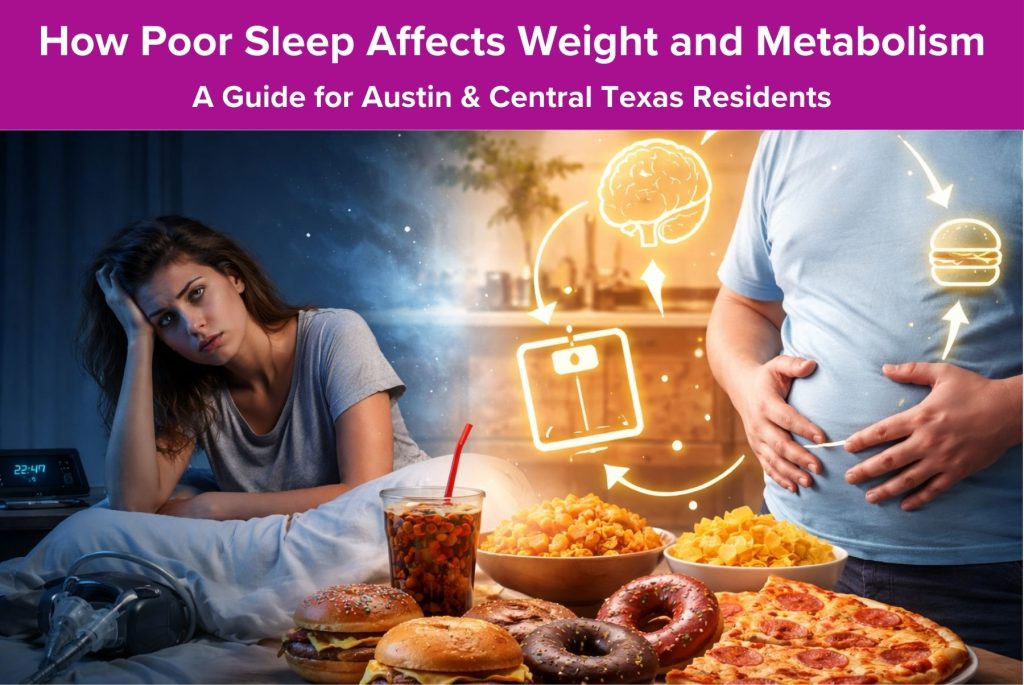
 A Guide for Austin & San Antonio Residents
In a city as vibrant as Austin, it’s easy to sacrifice sleep. Between late nights at Austin City Limits (ACL) Festival, lively weekends on South Congress, and road trips to San Antonio’s Día de los Muertos celebrations, many Texans find themselves running on far less sleep than their bodies need.
But poor sleep doesn’t just cause grogginess — it can significantly impact your weight, metabolism, and overall health.
At Sleep Medicine Consultants, we help patients understand the powerful connection between sleep and weight management. If you’ve been struggling with weight gain, stubborn metabolism, or constant cravings, your sleep may be playing a bigger role than you think.
The Science Behind Sleep and Metabolism
Sleep is not “downtime” for your body. It’s an active, restorative process that regulates:
- Hormone production
- Appetite control
- Insulin sensitivity
- Fat storage
- Energy metabolism
When sleep is disrupted or shortened, your body shifts into stress mode. Over time, this can lead to metabolic imbalance and weight gain.
How Sleep Deprivation Increases Cravings
If you’ve ever stayed up too late during the weekend and found yourself reaching for breakfast tacos the next morning, there’s a biological reason for that.
Lack of sleep disrupts two key hunger hormones:
1. Ghrelin (The “Hunger Hormone”)
- Increases when you’re sleep-deprived
- Makes you feel hungrier
- Encourages overeating
2. Leptin (The “Fullness Hormone”)
- Decreases with poor sleep
- Reduces your sense of satiety
- Makes it harder to feel satisfied after eating
This imbalance often leads to:
- Cravings for high-carb, high-fat foods
- Late-night snacking
- Larger portion sizes
- Reduced willpower around sugary foods
Sleep deprivation also affects the brain’s reward centers, making junk food more appealing. This is one reason why consistent poor sleep can sabotage even the most disciplined diet.
For individuals searching for sleep and weight loss in Texas, improving sleep quality is often the missing piece.
Poor Sleep Slows Your Metabolism
When you don’t sleep enough:
- Your body becomes more resistant to insulin
- Blood sugar regulation worsens
- Fat storage increases
- Resting metabolic rate may decrease
Chronic sleep restriction can push the body toward prediabetes and type 2 diabetes — conditions that are closely linked to obesity.
Even moderate sleep loss over time can make weight management significantly harder.
The Relationship Between Sleep Apnea and Weight
One of the most important connections we see at Sleep Medicine Consultants is between obstructive sleep apnea (OSA) and obesity.
What Is Obstructive Sleep Apnea?
OSA is a condition where the airway repeatedly collapses during sleep, causing:
- Pauses in breathing
- Oxygen drops
- Frequent awakenings (often unnoticed)
- Loud snoring
- Morning headaches
- Daytime fatigue
How OSA Contributes to Weight Gain
Sleep apnea disrupts deep, restorative sleep. This leads to:
- Hormonal imbalance
- Increased cortisol (stress hormone)
- Higher appetite levels
- Reduced energy for exercise
- Insulin resistance
Many patients struggling with weight loss discover that untreated sleep apnea is a major underlying factor.
In fact, research consistently shows a strong link between OSA and obesity in Texas, where rates of both conditions are higher than the national average.
Does Weight Cause Sleep Apnea — or Vice Versa?
The relationship works both ways:
- Excess weight increases the risk of airway collapse.
- Untreated sleep apnea makes weight loss harder.
This creates a frustrating cycle — but with proper diagnosis and treatment, that cycle can be broken.
Late Nights, Festivals, and Sleep Debt in Central Texas
Austin and Central Texas are known for year-round events:
- ACL Festival
- SXSW
- Holiday parades
- Día de los Muertos celebrations in San Antonio
While these events are worth celebrating, repeated late nights can accumulate “sleep debt.” Occasional sleep loss is manageable, but chronic sleep deprivation can:
- Increase belly fat
- Disrupt metabolism
- Reduce physical performance
- Increase long-term health risks
If you find that your sleep never quite returns to normal after busy weekends, it may be time to evaluate your sleep health.
Signs Your Sleep May Be Affecting Your Weight
You may benefit from a sleep evaluation if you:
- Struggle to lose weight despite diet and exercise
- Wake up feeling unrefreshed
- Snore loudly
- Experience daytime fatigue
- Have high blood pressure
- Have been diagnosed with prediabetes or type 2 diabetes
- Crave carbs and sugar when tired
Addressing sleep disorders can significantly improve both weight management and overall metabolic health.
Comprehensive Q&A Section
Q: Can poor sleep really cause weight gain?
Yes. Sleep deprivation alters hunger hormones, increases cravings, slows metabolism, and reduces insulin sensitivity — all of which can promote weight gain.
Q: How many hours of sleep are ideal for weight management?
Most adults need 7–9 hours per night. Consistency is just as important as duration.
Q: Why do I crave junk food after a bad night’s sleep?
Sleep loss increases ghrelin and decreases leptin, making you feel hungrier while reducing your sense of fullness. It also increases brain reward sensitivity to high-calorie foods.
Q: Does treating sleep apnea help with weight loss?
Treating sleep apnea can:
- Improve energy levels
- Stabilize appetite hormones
- Improve insulin sensitivity
- Support sustainable weight management
While it’s not a “weight loss treatment” by itself, it often removes a major barrier.
Q: Is sleep apnea common in overweight individuals?
Yes. There is a strong association between OSA and obesity in Texas and nationwide. However, sleep apnea can also occur in individuals who are not overweight.
Q: Can I have sleep apnea without knowing it?
Absolutely. Many people are unaware of nighttime breathing disruptions. Bed partners often notice symptoms first.
Q: Will improving my sleep boost my metabolism?
Better sleep improves hormonal regulation, insulin function, and energy balance — all of which support a healthier metabolism.
Q: How do I know if I need a sleep study?
You should consider a sleep study if you:
- Snore regularly
- Wake gasping or choking
- Feel exhausted during the day
- Have difficulty losing weight despite lifestyle changes
Take Control of Your Sleep and Metabolic Health
If you’ve been searching for answers about sleep and weight loss in Austin, professional evaluation can provide clarity. Addressing sleep disorders not only improves rest — it can transform your metabolic health, energy, and quality of life.
Contact Sleep Medicine Consultants
Sleep Medicine Consultants
📍 Austin Location
5929 Balcones Dr. #303
Austin, TX 78703
📞 (512) 420-9900
📍 San Antonio Location
4114 Pond Hill Road, Suite 101
San Antonio, TX 78231
📞 (210) 742-6682